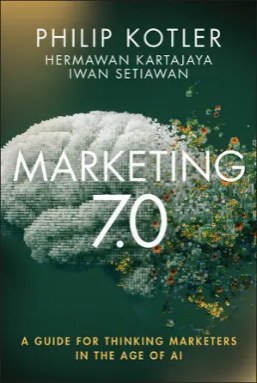
Philip Kotler, Hermawan Kartajaya, and Iwan Setiawan continue the evolution of modern marketing thought through their latest book, Marketing 7.0: A Guide for Thinking Marketers in the Age of AI. One of the key concepts introduced in the book is the idea of consumers as “augmented humans.”
The term augmented human describes how consumer behavior is increasingly being shaped and influenced by artificial intelligence (AI). As AI becomes more deeply embedded in everyday life, it is also playing a greater role in the way people process information, evaluate alternatives, and make decisions—including purchasing decisions.
Iwan Setiawan, co-author of Marketing 7.0, explains that constant exposure to AI-powered technologies and digital stimuli is gradually changing the way the human brain processes information and responds to its environment.
“We believe that three brain networks are undergoing significant changes: the attention brain, social brain, and reward brain,” Setiawan said during the HK Masterclass held at the Philip Kotler Theater Class in Jakarta on Tuesday, April 14, 2026.
These three brain networks provide a framework for understanding how technology is reshaping consumer behavior in the AI era.
Attention Brain
The attention brain refers to the way people process and filter the enormous volume of information they encounter every day.
Consumers are continuously exposed to advertisements, social media content, notifications, recommendations, and other forms of digital information—some relevant to their needs and many others not. As a result, the human brain has become increasingly accustomed to making rapid judgments about which information deserves attention.
Consumers can now instinctively identify and dismiss content that they perceive as irrelevant, often within seconds.
“If people see something they do not like, they simply scroll past it without giving it much thought. This is something very real that is happening in the human brain today,” Setiawan explained.
For marketers, this creates a significant challenge. Capturing consumer attention is no longer simply about increasing exposure. Brands must be able to communicate relevance almost immediately and deliver content that resonates with consumers within increasingly limited attention spans.
Social Brain
The social brain refers to the collective dimension of consumer thinking that is shaped by social interactions, communities, and digital networks.
It represents the part of human behavior that governs relationships, social connections, and the influence people have on one another. In today’s digital environment, consumers rarely make decisions entirely in isolation.
Their choices are increasingly influenced by other consumers, online communities, public opinion, social media conversations, and even the algorithms that determine what information appears in their digital feeds.
Three important mechanisms illustrate how the social brain influences consumer decisions: online reviews, customer testimonials, and recommendations from friends or peers.
These social signals can significantly affect purchasing decisions. For example, consumers may become more likely to choose a product simply because it has received high ratings or strong recommendations from other users.
For marketers, this means that brand communication is no longer entirely controlled by the brand itself. Consumer communities, peer-to-peer recommendations, and digital conversations have become increasingly influential in shaping brand perception and purchasing behavior.
Reward Brain
The reward brain refers to the part of the human brain that motivates people to seek pleasure, recognition, satisfaction, and positive emotional experiences.
From a consumer perspective, this means that purchasing decisions are not always driven by purely functional considerations. Consumers may choose certain products or services because they provide emotional satisfaction, enjoyment, comfort, or a sense of reward.
One example is the well-known lipstick effect, a phenomenon in which consumers continue purchasing relatively affordable indulgences—such as lipstick, cosmetics, snacks, or other small luxuries—even during periods of economic uncertainty or recession.
These purchases can serve as a form of emotional relief, helping consumers improve their mood or experience a temporary sense of pleasure despite challenging economic conditions.
The reward brain is closely associated with the brain’s dopamine system, which contributes to feelings of pleasure, satisfaction, and motivation. Digital platforms and technologies can further amplify these responses through instant gratification, personalized recommendations, gamification, and continuous engagement.
Understanding the Augmented Human
The concepts of the attention brain, social brain, and reward brain highlight an important shift in how marketers should understand consumers in the age of AI.
Technology is not simply providing consumers with new tools. It is also influencing how they pay attention, interact with others, seek satisfaction, and ultimately make decisions.
Through the concept of the augmented human, Philip Kotler, Hermawan Kartajaya, and Iwan Setiawan emphasize that effective marketing in the AI era requires more than technological capabilities and data analytics. Marketers must also develop a deeper understanding of human cognition, social behavior, and emotional motivation.
As artificial intelligence becomes increasingly integrated into consumers’ daily lives, the future of marketing will depend on the ability to combine technological intelligence with a deeper understanding of how people think, connect, and respond.
- #Marketing 7.0
- #AI
- #Consumer Behavior
Written by
Editor
Kotler Marketing Institute
The KMI editorial team curates articles, books, case studies, and research on how marketing leaders turn strategy into measurable growth.